
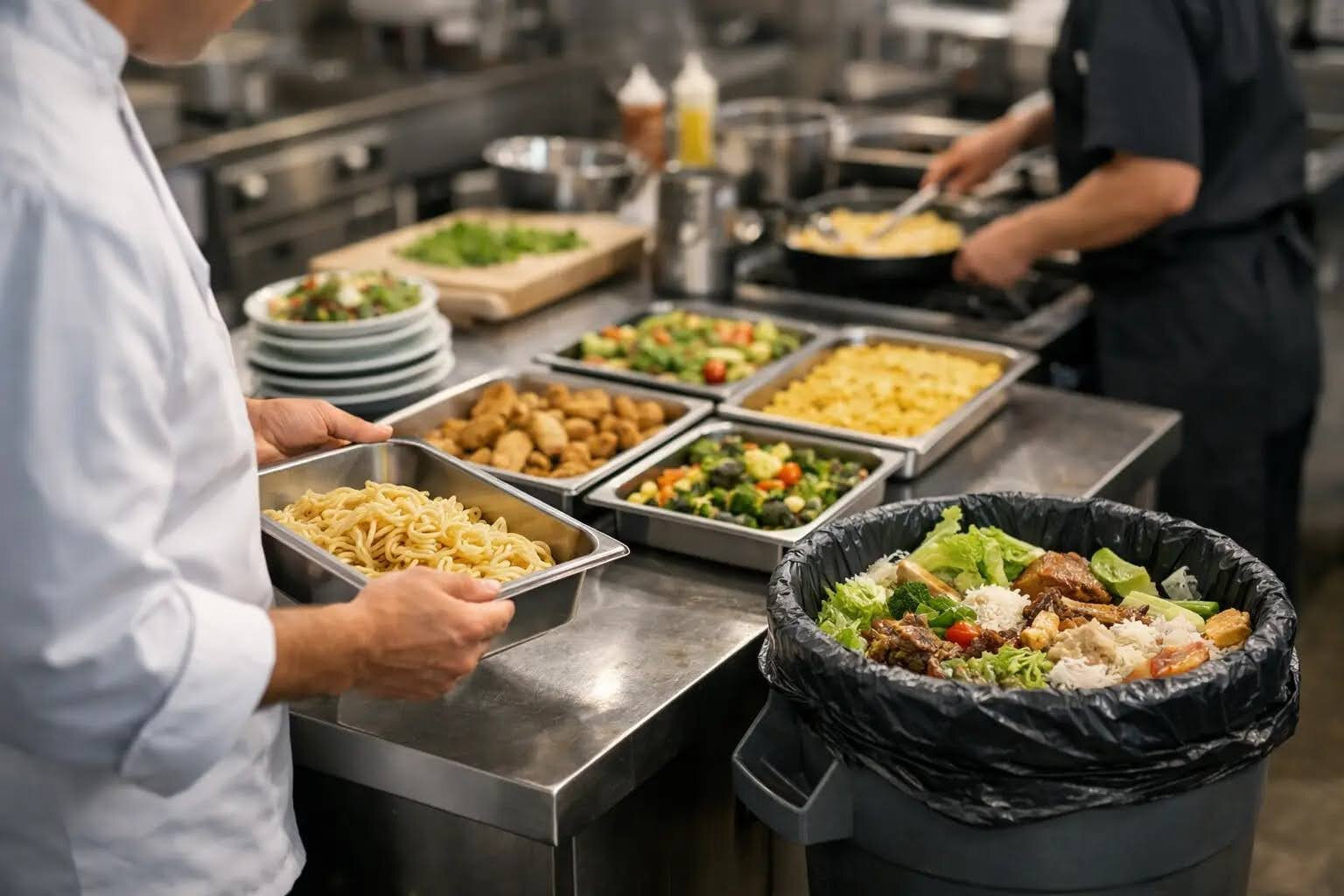
Overproduction is a production planning problem. It happens when a kitchen prepares more food than it serves or sells, and it usually starts with good intentions: an extra hotel pan for lunch, a backup batch for dinner, one more tray just in case.
By the end of the week, those small buffers add up to real money in food, labor, and disposal.
It's worth fixing. ReFED estimates U.S. foodservice had 12.5 million tons of surplus food in 2024, worth $157 billion, or 14% of foodservice sales. And the cost doesn't stop at the kitchen door. According to the EPA, food made up 24% of everything sent to U.S. landfills in 2018, more than any other material.
Most kitchens don't overproduce because teams are careless. They overproduce because running out feels worse than throwing food away, and because production plans are built on estimates instead of what guests actually ate.
The fix is better demand forecasting: compare what was prepared with what was consumed, then adjust one meal period at a time. Here are six ways to do that.
Quick answer: Commercial kitchens reduce overproduction by planning batches from what was actually served, not past production habits. Track what is produced, served and left over for each menu item, cook high-variance items in stages, fix dishes that are consistently over-made, review results weekly and share the data with purchasing.
The 6 steps at a glance
- Forecast demand from actual consumption data, not past production.
- Track production, servings and leftovers, not just waste.
- Stage batches for high-variance and short-hold items.
- Use item-level data to fix menus and portions.
- Run short daily or weekly production reviews.
- Connect kitchen data to purchasing.
Why does overproduction keep happening?
The biggest driver is demand uncertainty. Kitchens have to make production decisions hours or even days before guests arrive. When demand shifts with seasonality, weather, promotions, events, or changing preferences, rough estimates and old habits quickly stop matching reality.
Running out of a popular item frustrates guests and disrupts service fast. So chefs build buffers into prep sheets, pars, and batch plans. Over time, those buffers become routine even after demand has changed, and overproduction gets accepted as the cost of doing business.
Manual logs make the problem harder to see. If production, leftovers, and waste are recorded inconsistently, or not at all, nobody can tell where estimates have drifted. Without item-level data, a par that was set months ago keeps running long after the demand behind it has dropped.
The items most likely to be overproduced
Across Metafoodx customers, chicken, eggs, and rice consistently rank among the most overproduced items. They are core to many menus, relatively inexpensive per unit, and used across many dishes, so they tend to be cooked in large batches ahead of service.
That makes them easy to over-make. A small miss on demand turns into a large volume of surplus, and once cooked, these items have short holding windows. If they aren't used in time, they get thrown out.
What overproduction really costs
Overproduction costs more than the food in the bin. Extra production means extra labor, ingredients, cooling and storage space, and time spent handling leftovers after service. It also inflates usage numbers, which pushes purchasing to order more than the kitchen needs.
1. Forecast demand with actual consumption data
The fastest way to improve production planning is to compare planned quantities with actual consumption at the menu-item level. Meal counts help, but two days with the same number of covers can move very different items depending on the menu mix.
Build forecasts from recent consumption history, not historical production habits. Look at what was served, what came back as leftovers, and which items consistently missed the mark. Then reset pars based on that evidence.
This matters even more across multiple sites. One dining hall may need a different production curve than another because of class schedules or athlete traffic. One hotel outlet may swing more with group business than another. Consistent reporting lets operators adjust locally while managing performance across the whole program.
Our guide to AI food demand forecasting covers this in more detail.
2. Track production, not just waste
Many kitchens measure what ends up in the trash, but waste is only the final outcome. To understand why overproduction happens, you also need to know what was produced, what was served, what was left over, and where those leftovers went: reused, donated, or composted.
A food waste tracking system that captures this in seconds removes the need for handwritten notes and end-of-shift estimates. Metafoodx records menu item, food weight, temperature, and disposition in about two seconds, so teams can see how much was produced and how much remained after service without adding manual work.
That detail matters because overproduction has different causes. Sometimes an item is chronically over-forecast. Sometimes portions are too large. Sometimes backup batches go in too early because nobody trusts the demand signal. Each needs a different fix.
3. Tighten batch cooking without risking stockouts
Batch cooking is one of the best production planning controls when it's structured well. Start by deciding which items should be cooked in staged batches and which need a full initial run.
High-volatility items, foods with short holding times, and items with inconsistent demand are usually the best candidates for smaller batches. Staples like chicken, eggs, and rice often belong here too. Predictable items may not need much change.
Keep labor in mind. Smaller batches reduce overproduction, but if they require constant re-firing or pull skilled staff away from service, the savings can disappear. Focus first on categories where overproduction is frequent and product cost is high.
Give teams clear triggers for the next batch, based on how much is left, current traffic, and expected demand for the next interval. That creates control without inviting shortages.
4. Use item-level data to fix menu and portion issues
Not every overproduction problem is a forecasting problem. Sometimes the kitchen is making the right quantity of the wrong menu. If a dish consistently underperforms, cutting the batch size may help, but reformulating, repositioning, or replacing it may help more.
Item-level tracking separates weak demand from execution issues. An item might lag because it's unpopular, or because it appears too often, is merchandised poorly, or sits next to a stronger option.
Portioning deserves the same attention. When operators know production weight and served volume, they can tell whether the issue is too much food being cooked or too much food being plated. For more on this, see what causes restaurants to misjudge portion sizes.
5. Make production reviews part of the routine
Overproduction won't improve if the only review happens at month end. Teams need short feedback loops during the week, by station and menu category.
Executive chefs, dining directors, and multi-site leaders should be able to see recurring overproduction by item, meal period, outlet, and disposition. If one site routinely overproduces scrambled eggs on weekdays or composed salads on quiet Fridays, that pattern should be obvious.
Dashboards and automated reports make this possible without hours of spreadsheet work. They let managers compare locations and shifts, test changes without adding risk, and coach from data instead of memory. A daily production review is a simple place to start.
Programs that measure consistently see results. UMass Amherst Dining cut overproduction by 51%, and Pomona College reduced food overproduction by 54%.
6. Connect kitchen data to purchasing
Production mistakes ripple back into ordering and inventory. If overproduction is common, purchasing may read inflated usage as real demand and keep buying too much. Then the cycle repeats.
Sharing production and leftover data with procurement breaks that cycle. When consumption trends are visible, order quantities can be adjusted with more confidence. Better control also improves donation and reuse planning, because teams know what surplus exists and when it appears.
How much can kitchens reduce overproduction?
Results depend on the starting point, but kitchens that measure production by item usually find the biggest gains in the first few months. Here is what three Metafoodx customers have seen:
| Operation | Result | Timeframe |
|---|---|---|
| UMass Amherst Dining | 51% less overproduction | 3 months |
| Pomona College | 54% less overproduction | 9 months |
| Mayan Princess Beach & Dive Resort | 23% less overproduction, 820% ROI | 6 months |
Producing the right amount
Reducing overproduction isn't about cooking less. It's about cooking to demand.
By forecasting from consumption, tracking production alongside waste, tightening batches, fixing menu and portion issues, reviewing regularly, and sharing data with purchasing, commercial kitchens can protect food cost, guest experience, and sustainability goals at the same time.
Want to see what overproduction does to your margins? Use our free food cost calculator to find the waste hiding in your food cost percentage.
Frequently asked questions
What is overproduction in a commercial kitchen?
Overproduction is food that is prepared but never served. It is the biggest source of waste in most commercial kitchens, and it adds food, labor, storage and disposal cost.
What causes overproduction in commercial kitchens?
Demand uncertainty and fear of running out. Without data on what guests actually eat, kitchens build buffers into prep sheets and forecast from past production instead of consumption, so production targets stay higher than needed.
Which foods are most often overproduced?
Across Metafoodx customers, chicken, eggs, and rice rank among the most overproduced items. They are inexpensive, used in many dishes, and cooked in large batches ahead of service, so small forecasting misses add up quickly.
Why is production data more useful than waste data alone?
Waste data shows what was discarded but not why. Production data shows what was prepared, served, consumed, and left over, which makes it easier to find the items and meal periods where forecasting or portioning needs to change.
How often should production performance be reviewed?
Daily or weekly. Short, regular reviews help teams catch recurring overproduction early and adjust production targets before the same mistake repeats.
How does Metafoodx help reduce overproduction?
Metafoodx identifies menu items, measures food weight, monitors temperature, and records production and leftovers in about two seconds. Dashboards and reports then show which items are consistently overproduced and where batch sizes, prep schedules and purchasing can be adjusted, without adding manual logging for kitchen staff.
Related reading: Metafoodx Enhances AI-powered Weekly Reports to Help Kitchens Reduce High-Cost Overproduction · AI Food Demand Forecasting
Metafoodx is a food operations intelligence platform that captures the food journey from prep to plate, so foodservice teams can lower food cost, produce more accurately, and prevent waste before it happens. Ready to see how we can help transform your food service operation? Book a demo with our team today.